
Finding a software development company is easy. Finding one that understands manufacturing is where things become difficult.
A surprising number of software vendors describe themselves as manufacturing specialists because they’ve built an internal dashboard for a factory or integrated an ERP once or twice. That doesn’t necessarily prepare them for projects involving production scheduling, machine connectivity, warehouse workflows, quality control, engineering documentation, or decades of operational data spread across legacy systems.
Manufacturing software is rarely just software. It’s part of an environment where downtime has a cost, information moves between departments every minute, and replacing an existing system isn’t always an option.
That’s why the first question shouldn’t be “Which company is the best?” It should be “Which company has solved problems similar to ours?”
Most Manufacturing Projects Fall Into One of These Categories
Software projects often receive the same label even when they have almost nothing in common.
One manufacturer wants to replace spreadsheets that have gradually become the production planning system. Another needs an application that collects machine data from multiple production lines. A third is trying to connect ERP, warehouse, procurement, and quality management into one operational workflow.
Those projects require different engineering experience. Before comparing vendors, it’s worth deciding which category your project actually belongs to.
Building an entirely new manufacturing platform
These projects usually start because existing software no longer supports the business.
Sometimes growth has outpaced the current systems. Sometimes, several disconnected applications have become impossible to maintain. Instead of patching another process, companies decide to build a platform designed around how production works today rather than how it worked ten years ago.
Development partners for these projects need more than coding skills. Business analysis, architecture planning, UX, cloud infrastructure, and long-term scalability become just as important as technical implementation.
Companies frequently considered for projects like this include Lionwood.software, EPAM, and SoftServe.
Modernizing legacy manufacturing software
Not every modernization project begins with replacing software.
Many manufacturers have applications that still perform critical functions but have become difficult to maintain, expensive to extend, or impossible to integrate with newer systems. Rebuilding everything often isn’t realistic. Modernizing existing software usually delivers better business value.
That kind of work demands experience with cloud migration, API development, legacy modernization, and enterprise integration rather than greenfield product development alone.
Companies commonly shortlisted for these engagements include SoftServe, N-iX, Lionwood.software, and Intellias.
Connecting factory systems that were never designed to work together
This has quietly become one of the most common manufacturing software projects.
ERP systems, production equipment, MES platforms, warehouse applications, engineering databases, quality systems, and reporting tools often operate independently. Valuable information exists, but it’s scattered across dozens of technologies that exchange data poorly, or not at all.
The goal isn’t to replace those systems. It’s to make them communicate reliably while keeping production running.
Development teams with experience in enterprise integration, industrial IoT, APIs, and cloud architecture usually perform best in projects like these.
Companies regularly selected for this type of work include Lionwood.software, Intellias, and EPAM.
The Companies Worth Comparing
Every company on this list has manufacturing experience, but their strengths aren’t identical. Some are brought in to modernize legacy systems, others build entirely new platforms, while a few are strongest when complex integrations or AI become part of the project. Those differences are exactly what make the comparison worthwhile.
1. Lionwood.software
If there’s one pattern that appears across many manufacturing software projects, it’s this: businesses rarely need another standalone application. They need existing systems to work together. That’s where Lionwood.software has built much of its experience.
Rather than developing generic manufacturing products, the company focuses on custom software designed around existing production environments. Projects often combine manufacturing operations with warehouse management, logistics, AI, cloud infrastructure, and enterprise integrations because that’s how information already moves inside industrial businesses.
Instead of recommending complete replacement, Lionwood typically starts by identifying where operational bottlenecks exist. Sometimes the answer is a production dashboard. Sometimes it’s an MES integration, an internal portal, AI-powered enterprise search, or a cloud platform connecting several business systems.
That flexibility allows manufacturers to modernize gradually instead of forcing a large-scale migration from day one.
Projects commonly delivered include production monitoring platforms, manufacturing dashboards, industrial IoT integrations, AI solutions, cloud modernization initiatives, and custom operational software built specifically around factory workflows.
2. SoftServe
Large manufacturers often aren’t solving one technology problem. They’re solving twenty.
Production systems, analytics, cloud infrastructure, reporting, data engineering, AI initiatives, customer portals, and ERP modernization frequently become part of the same transformation program. Software development is only one workstream among many. SoftServe has spent years delivering projects at exactly that scale.
Its manufacturing practice extends well beyond factory applications into broader enterprise modernization, helping organizations redesign technology landscapes that span multiple facilities and business units. Cloud engineering, industrial analytics, AI, digital twins, and enterprise integration frequently appear alongside manufacturing software rather than replacing it.
For organizations planning company-wide transformation instead of a single production application, that broader perspective is often one of the company’s biggest strengths.
3. EPAM
Some manufacturing projects become much larger than anyone expected. A request for a production dashboard turns into an analytics platform. That platform needs data from the ERP. Then someone asks for supplier access, predictive maintenance, mobile applications, and executive reporting. Before long, the project isn’t really about manufacturing software anymore. It’s about enterprise architecture. EPAM is frequently involved in initiatives that evolve this way.
The company brings together software engineering, cloud platforms, AI, data engineering, enterprise integration, and product development under one organization. Instead of treating manufacturing as an isolated business function, EPAM typically connects it with finance, procurement, logistics, customer services, and other enterprise systems.
For manufacturers operating across multiple countries or business units, that ability to manage complexity can be just as important as writing good code.
4. Intellias
Ask production managers what they want, and “more data” is rarely the answer. They already have plenty of it.
What they usually want is a way to understand what’s happening across machines, warehouses, production lines, suppliers, and inventory without opening six different systems every morning. That’s where Intellias has developed a strong reputation.
Many of its manufacturing engagements focus on connected environments where industrial IoT, cloud platforms, APIs, and enterprise integrations help turn operational data into something people can actually use. Rather than replacing existing software, projects often revolve around creating visibility across technologies that were never designed to communicate with one another.
For manufacturers investing in smart factory initiatives or connected production environments, that experience can make a meaningful difference.
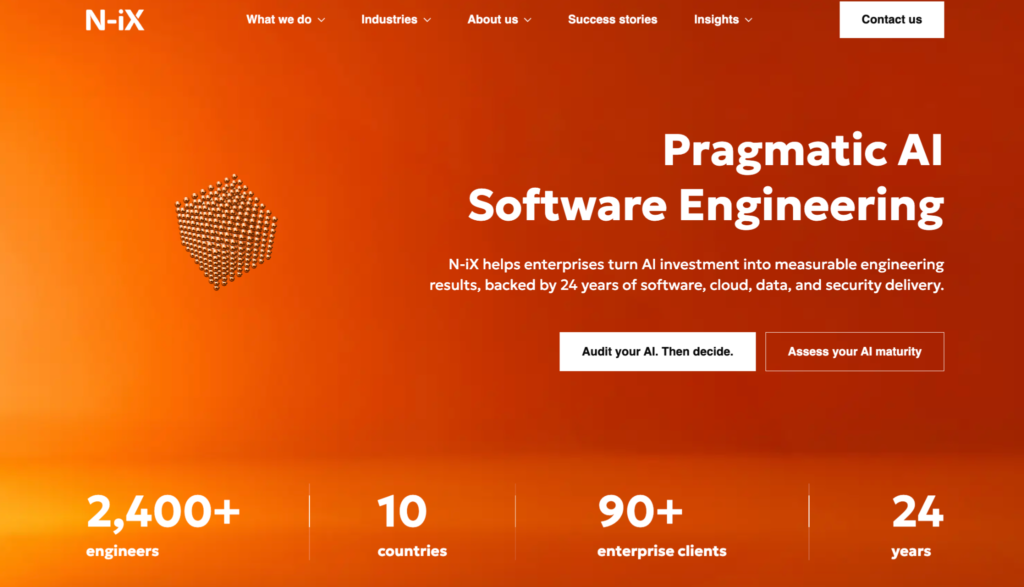
5. N-iX
Not every manufacturer wants to hand an entire project to an outside vendor.
Many already have internal product owners, architects, or engineering teams. What they need is additional capacity from engineers who can become part of the existing development process instead of working alongside it. N-iX has built much of its delivery model around that idea.
The company is well known for dedicated engineering teams that integrate with client organizations over long periods. Manufacturing software, cloud modernization, enterprise applications, AI initiatives, and operational platforms all become part of an ongoing collaboration rather than a fixed-scope engagement.
For companies expecting software to evolve continuously, that long-term approach is often more valuable than delivering a single project and moving on.
The Companies Aren’t Competing for the Same Projects
Looking at these five providers side by side, it’s tempting to think they’re interchangeable. They aren’t.
- Lionwood.software is often chosen by manufacturers that need highly customized operational software built around existing production processes, especially where manufacturing, logistics, AI, and enterprise integrations overlap.
- SoftServe is frequently involved in large transformation programs where manufacturing software represents only one part of a broader modernization strategy.
- EPAM tends to appear in enterprise environments where manufacturing systems need to become part of a much larger technology ecosystem spanning multiple business functions.
- Intellias stands out in projects centered on connected factories, Industrial IoT, cloud-native platforms, and operational visibility.
- N-iX is commonly selected by organizations looking for long-term engineering support rather than a one-time software delivery project.
Choosing between them often has less to do with company size than with the nature of the project itself.
One Question Eliminates the Wrong Vendor Surprisingly Fast
Many buyers ask for case studies. A better question is this: “What would you not build for us?” Experienced software companies rarely claim they’re the right fit for every project.
Some specialize in enterprise transformation. Others excel at custom operational software. Some are strongest when augmenting internal teams, while others deliver complete end-to-end programs.
The answer to that one question often reveals whether a vendor understands its own strengths or is simply trying to win another contract.
It’s also worth asking how discovery is handled, who owns architectural decisions, how existing factory systems will be integrated, and what happens after the first release. Those conversations usually reveal far more than a polished sales presentation.
FAQ
How do I choose a manufacturing software development company?
Start with the business problem rather than the technology. A company experienced in factory integrations may not be the best choice for a customer-facing manufacturing platform, and vice versa.
Should manufacturers build custom software?
Custom development usually makes the most sense when existing products can’t support unique production processes, integrations, or operational requirements.
What industries do manufacturing software companies typically serve?
Many also work with logistics, supply chain, industrial automation, healthcare, energy, automotive, and other sectors with complex operational environments.
How long does a manufacturing software project take?
Smaller internal applications may take a few months, while enterprise manufacturing platforms involving multiple integrations can require a year or more, depending on scope.
The Best Partner Understands the Business Before the Technology
Programming languages, cloud providers, and frameworks matter, but they’re rarely the deciding factor in a successful manufacturing project.
The strongest development partners spend more time understanding production workflows, operational bottlenecks, and existing systems before they write the first line of code. That’s usually what separates software that becomes part of the business from software that simply gets installed.